sights, sounds & smells of Accra

after six weeks of living in accra, it feels like a long list has accumulated in my mind's eye for experiencing many new sights, sounds & smells here.  for most of my adult life i have felt like i had a sense of what ghana was like -- perhaps through my friend's stories, articles, college courses...i'm not really sure.  i have seen the traditional, round & colorful baskets being sold in the u.s., as well as the kente cloth which is so internationally known.  i had an image of village life with fires cooking food, basins full of clothes being soaked for washing, tropical plants creating a density of lush greenery all around, thatched roofs keeping the rain out, dirt paths and roads to carry people, bicycles and trucks, and children on mamas' backs snuggled under beautiful patterned fabrics.

now that i am living in accra (which is far from village life), i have come to see that i had no real concept of this land and its peoples whatsoever.  aside from the fact that we're living in a city and not a village, i could never have imagined or known what life is like here.  i also realize that even if we have great interest in other nations and their cultures, we are far removed from the details of life that make each one unique and distinguished from one another.

the first aspect of life here that struck me with great surprise is the lack of infrastructure.  paved roads do exist but they are not common enough to make one feel like it's normal.  dirt roads intersect paved roads along common roadways in every neighborhood.  the dirt roads are so bumpy and rocky, with uneven rivets as a result of heat and heavy rainfull, that only the 4x4s can get through them with a sense of ease.  when you factor in the traffic and chaos which typify life on the roads, it becomes an experience that challenges whatever sense of accomplishment one had felt in the virtue of patience.  every simple trip from one neighborhood to another becomes almost an ordeal.  if you add in two additional factors -- the presence of police who are eager to find any reason to fault you and send you to the local station unless you offer a bribe, and the endless stages of highway construction which create massive bottlenecking or the lack of maintenance of the roads (potholes, broken gutters, eroding asphalt along the edges of the road) -- the errand that should take a half an hour is easily more than an hour.  we must take all of these factors into consideration when needing to use a vehicle when traveling around.  somehow other countries like tanzania, mozambique and cote d'ivoire -- all 'developing' nations -- have managed to create cities that have great infrastructure and modern landscaping.  accra has some very nice hotels but surprisingly, it has no area which facilitates people to travel with ease and enjoy restaurants, beaches, and other typical tourist attractions.
it is common to see broken coconut shells on the side of the road, littered plastic water bags (which are sold much more often than water bottles), people carrying local foods on their heads, lizards scurrying into hiding spots, corn stalks growing on lawns instead of grass, urban gardens in public lots, and women dressed in gorgeous, traditional outfits to take care of their daily business.  there are always container shops or wooden stands selling a variety of essentials, snacks, local cuisine and produce.  i like how they are interspersed with official businesses and in all kinds of neighborhoods.  accra is still a city that has people of all classes living side by side.  those who are striving to make a living by selling goods open up containers in front of their homes.  it fascinates me to see how this is occurring -- there are no laws preventing people from 'setting up shop' so it's nice to see people being able to create business opportunities for themselves.  i especially like how tables with umbrellas are set up for those who can't afford something more substantial.

when we first arrived we noticed there are sounds that are new or unusual.  one is the constant pumping of a rubber horn, the kind that clowns in america use sometimes.  it is used to alert neighbors that the vendor is nearby with food to sell.  typically it's fried foods, ice cream and ghanaian meals on the go.  it sounds like a bird calling, with repetitive honks, usually 8-10 in a row, with a pause in between before it repeats again.  another sound we hear about 2 times a week is a loud announcement on a megaphone from a car that randomly rides by.  several times we've heard it around 6:30 in the MORNING.  to me it depicts the scene in a film about africa when the rebels are announcing something about the 'cockroaches' -- as if we're preparing for war. 

the familiar sound of cars honking to get a guard's attention to open the gate to residential homes is now a normal part of life.  most of the time these big homes or compounds have little rooms inside the property for the guard to sit.  when the car arrives it beeps a couple of times and waits for the gate to open.  there are NO automatic gates in accra -- it's definitely odd how a lot of money is spent on expensive homes and security fences or barbed wire but no one has automatic gates (which they do have in south africa).  we are now a part of the beeping system because dash's company, olam, provides a driver and insists that wherever we live we have a security guard.  this is necessary to the company because the house we live in is furnished by the company.  the driver service is not my favorite aspect of life in accra, but i am learning to appreciate the advantages it offers -- like avoiding the stress and hassle of life on the roads (our driver was already sent to the police station one time and had to pay a small fine for talking on the cell phone).

one sound that we find brings a smile to our faces is the wide variety of musical rhythms one can hear anywhere at anytime.  cell phones around the world are now full of ringtones; it is fun to hear songs and melodies in ghanaian languages that we've never heard before.  the loudest and most festive sounds come early in the evening until way past midnight, but music in africa is so woven into the fabric of daily life that it's more of a 24/7 sound:  it can be heard by women singing gospel while ironing, washing or cooking, to dj's and big speakers blasting reggae, house music and local sounds at clubs and bars throughout the city.

smells leave a unique impression on us.  the biggest smell here that i love is burning trash.  it brings me instantly to jamaica where the hint of citrus scent is intermingled with piles of waste burning in backyards and the sides of streets.  each time i smell it i feel connected to life for all people in the tropics, where mango and avocado trees grow with lemon, orange and banana trees.  most families find burning waste an easy solution to accumulated waste.  it may not be ecologically beneficial but it certainly is the practical way to deal with the reality of accumulating waste.  now that i am living here, and not just a visitor, i am eager to discover ways to bring sustainable solutions to the needs of daily life.  i am hoping that the accumulating sights, sounds and smells of accra will inspire me to do so. :)

radiant acquiescence: a jr. youth story


this is Sami Naki, in the blue.  i've written about him before but he's worth mentioning again.  he is one of the gems in our life.  i think about him everyday.  his birthday was yesterday; he turned 13.  Sami is a charismatic soul, full of energy to sing, dance, draw, write & serve.  whenever he knew a celebration was coming up, he'd prepare traditional Xhosa dances to perform; if he was touched by something at children's classes, he would write me a letter expressing his feelings; during free time after classes he loved to draw and paint pictures of love; and he was one of the lead singers of the Baha'i school choir -- what a voice God has given him!  what i vividly remember the most is how he will instantly arise to be of service:  cutting food into small portions so all can share..fetching wood for the bon fire..planting seeds or seedlings for the community garden..being the leader of a group project..helping adults with anything they needed..and being a loving brother to all of the children.
traditional dancing after devotions at the Somni's home
when i met Sami he was 9 years old.  he lived in one of the small, concrete homes in the neighborhood of Delft, not unlike the other children.  inside his home there was no refrigerator, no oven, a shared kitchen/living area with a shelving unit that separated the back of the home where 2 beds lay close to each other.  the two burners on a transportable stove were where he'd fry a shredded potato for his meal without any assistance.  this was his basic meal.  most of the time he came to class hungry.  
it's hard to know if someone is hungry unless you are with them all day and realize they have not eaten and have no food at home.  one time sami was crying because he and his little sister were home and were so hungry.  i thought of Abdu'l-Baha.  my heart was aching.  aside from bringing refreshments for 20-50 children and youth each time, our visits were limited in terms of how we could help the neighborhood in material ways.  but this was a moment where i knew it was essential to provide sustenance to my little brother and sister.  we walked to the tuck shop and bought a few eggs, a loaf of bread and a few potatoes.  we returned to his home and it was time for me to leave.  sami couldn't express his feelings in words at that moment; instead he hugged me tightly as if it was our last time together. 

Sami's parents divorced in the first year of us knowing him.  he was 11 years old and without any parental support for most of the days of his life.  his dad had moved out; his mom almost never came home.  his 2 older sisters supported him and his little sister the best they could and with very little means, but with a lot of love and unity.  early in 2010 his dad decided to sell the house that Sami's mom and sisters were living in.  it was heartbreaking.  none of them wanted to leave the neighborhood they had grown up in.  they were forced to leave without preparation.  Sami and his sisters were crying.  i was crying.  they had to go live with their mother's brother in a shack in Nyanga.  sami began walking from Nyanga all the way to Delft (about 2 miles) to go to school.  and since he didn't want to miss Baha'i school on saturdays, he usually slept at someone's house on friday nights.  after some time passed, he started living with one of the family's in Delft until December school break.  he now goes to school in Gugulethu which is closer to where he lives and he no longer walks to Delft for Saturday activities.
sami being silly with joy while eating refreshments
sami's home in Nyanga is smaller than the house in Delft.  it is a typical shack made of scrap wood with a tin roof.  somehow there is electricity hooked up so an electrical stove and kettle can cook food and heat water.  there is no refrigerator or tv.  there is very little space inside the 2 rooms.  it manages to sleep 6 of them (now 7 since his older sister had a baby).  my one visit there over the sandy, rocky narrow pathway was full of prayer because the tires often spun without control in the sandy spots.  this was the only time i drove in an area of cape town that was full of shacks -- very few cars make their way off the main roads to enter in those areas, and no one there had ever seen an 'umlungu' (non Xhosa person) come to visit.  i was greeted by warm smiles full of surprise and apprecation all wrapped up into a friendly greeting.  i didn't see where sami goes to wash or use a toilet, but it was a discussion that i had with my children whenever they began to complain about any inconvenience or material difficulty in their lives -- i reminded them how sami must walk somewhere in the middle of the night if he needs to empty his bladder...  our visit together was full of Xhosa hospitality; it was one of those moments in my life that leaves an eternal imprint on my soul.
sami leading the study group in preparation for the Baha'i contest

sami with his close friend, yolanda -- the first time i went to delft they showed me their traditional xhosa dances
i can no longer visit sami.  i sometimes open my prayer book and read one of the letters he wrote expressing his love and gratitude for the children's classes.  although i have tried to call his sister's cell phones, i have only once been able to reach them (yesterday on his birthday) but he was not home.  sami's life in the township isn't one of staying inside at home most of the time.  it is out wandering around and about, hanging out with friends, playing soccer, dancing and celebrating culture, and attending church activities.. i know sami's life was touched by Baha'i school and the teachings of Baha'u'llah, helping him to 'have the confidence to do the right thing' (in his own words), but i wonder how his soul is managing to handle the pressures of a materialistic, morally decaying society around him.  he is one of the millions of jr. youth in the world who have immeasurable capacity to make this world a better place....

the photos below are taken during our first bon fire.  all of the children and jr. youth gathered sticks, crates to sit on & parafin to light the fire.  it is one of our favorite memories in delft.  we worked together as a group, sang a lot of songs and enjoyed each other's company as long as we could, being warmed by the fire, as the sun sank and the air became too cool to bear.  while the sun was setting, the kids started jumping over the fire with great enthusiasm and excitement. 


story: life in ghana

we are staying at a guest house in Accra until we find a house to live in.  we have been here for 2 months and it continues to be an interesting experience, to say the least.

yesterday the boys kicked the soccer ball over the tall wall of the compound into the adjacent cemetery. they explained to me that their 2 friends didn't want to enter the cemetery alone. so i did the natural thing and jumped up from my seat, slid on my sandals, walked down the stairs, opened the heavy gate of the compound and began walking around the side of the compound along a rocky, dirt path that often smells like urine by the time it reaches the intersecting market-lined street.

about half a block down the market-lined road we entered through an opening of a cement wall that looked like we were entering an abandoned lot. tall grass was interspersed with rows of baby cornstalks, the tiniest chickens i've ever seen, and about 15 old tombstones. i followed the two local boys along the dirt pathway which led to the family's home. set partly under an old, large tree, the light blue colored, wooden home had 2 young women sitting in the doorway braiding hair. after a friendly greeting, i noticed their surprise that i could say 'thank you' in the local 'twi' language. they gave their permission for the boys to retrieve the ball and went back to braiding.

i realize now that i didn't take in much detail of the home itself. i was immediately attracted to the woman who woke up from her nap. she sat up on the bench which was put together with scrap pieces of wood, and with a bright smile she motioned for me to come sit next to her. we were under the tree -- in front of us was a dirt courtyard area; behind us were many baby cornstalk plants in perfect rows shooting up as a result of the rainy season that began last month. in the corner of the garden area was a large compost area next to a shed.

after sharing some greetings in twi, the elderly woman explained what all of the tattoos on her arms and legs meant. the young woman came over and explained to me in english what the woman was saying -- apparently the tattoos were very painful but she was proud of them: gardening shears, a scorpion, a butterfly, a bird & a watch (on her wrist). just when i was in the moment of this special moment, the boys returned with the ball. we hugged and said goodbye.

it felt like i walked into a world that was rich with stories of survival, cooperation, innovation and dignity. it reminded me of the kind of movie, like The Lion, the Witch and the Wardrobe, where a child enters a whole new world which is magically connected with yet completely different from the one from which the child lives in. we are staying in a giant guest house in a neighborhood full of big homes and large yards. behind us is a world of full of material poverty. 

i like entering new worlds and find myself drawn to the ones with less material comforts yet more humility and love -- it is there i find myself full of joy.  the woman in the cemetery is one of God's gems in the web of humanity's oneness; she enriched my life in that short moment together.

millionaires wanting taxes to be increased

today i listened to an NPR interview with a few of the millionaires who have asked the President & Congress for an increase in taxes to help offset the fiscal budget crisis.  it was the first time i've ever heard of the wealthy responding in this way to the spirit of Baha'u'llah's Teaching:
That is why, in the Religion of God, it is prescribed and established that wealthy men each year give over a certain part of their fortune for the maintenance of the poor and unfortunate. That is the foundation of the Religion of God and is binding upon all.
And as man in this way is not forced nor obliged by the government, but is by the natural tendency of his good heart voluntarily and radiantly showing benevolence toward the poor, such a deed is much praised, approved and pleasing.
(Abdu'l-Baha, Some Answered Questions, p. 277)

i long to see individuals with wealth and means voluntarily offering what they have for 'the poor and unfortunate'.  the world continues to suffer because we, as individuals, talk of ideals instead of making decisions that transform our lives and the society around us.  this endeavor by the millionaires is commendable and a good beginning..and most of all rewarding for all.

South Africa: photo memories from cape town to durban


this is how our vacation began and ended..with joy!  traveling along the coast from cape town to durban..

Drawing in the sand on a chilly and rainy summer day


i love the eastern cape scenery of village life

we enjoy leaving our footprints in the sand at Chinsta beach
cleaning up after the traditional Xhosa wedding

Khonaye and Zoliswa

Domani, Ayana and Dyami Douglas

cutting greens for over 100 people to eat
traditional rondeval

what joy watching the Xhosa ladies in the village chat with each other
learning all about mealies
visiting Steve Biko's resting place: Domani Biko Douglas :)


Bittersweet: The cocoa industry

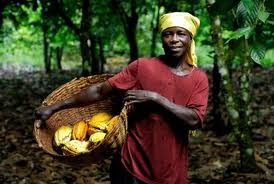
i am learning about the cocoa industry.  while it entices my digestive enzymes for chocolate, the industry in general increases my desire for justice and sustainability because it is dominated by powerful companies, moneymakers and landowners who have very little regard for the farmers who do all the hard work to harvest the cacao beans. 

In addition to the issues of justice for the farmers, it is important, also, to consider the ecological implications for the farmland.  There are challenges for growing cacao trees:
  • It only thrives in climates 20 degrees north and south of the equator;
  • It must be planted next to taller trees whose leaves will protect it from direct sun and high wind;
  • It is susceptible to pests and disease which routinely destroy one-third of the world’s yearly crop.
In addition, the trees are not very productive. Consider:
  • A tree must be five or six years old before it will bear fruit.
  • Each tree bears about 30 usable pods a year, which translates to roughly 1000 beans a year.
  • It takes 500 beans to make 1 pound of bittersweet chocolate – so in the best of circumstances, each tree produces beans for only 2 pounds of chocolate.
Most of us from America and Europe have grown up clueless about this industry.  We have been spoiled with an abundance of opportunities to eat chocolate.  This is true for most of the industries of the world -- we have to go searching to find some rare headline about the injustices and abuses against farmers in the world, or to discover the very difficult procedures and processes that raw materials experience by the hands of these farmers.  For the first time in my life, i am discovering what is involved before a bar of chocolate reaches the market.  What i am learning is that almost all of the millions of farmers (including children) who grow and prepare the cacao beans receive very poor wages for their labor in this lucrative industry.

Fair trade is a relatively new concept but is gradually making strides for a relatively small number of farmers.
Presently, cocoa sold with the Fair Trade label still captures a very low share of the cocoa market (0.1%).
by fair trade agreements there are now stories of individuals feeling empowered and economically secure. The important thing now is for me to change my habit of purchasing chocolate that isn't grown by fair trade.  I enjoy Snickers bars, Reeses peanut butter cups, Duncan Hines brownie mixes, and Nestle's semi-sweet chocolate chips!  I have steered away from the organic chocolate because it is expensive.  But now that i have knowledge, i can make no excuse to justify my purchase of these kinds of products.  I must abstain or admit that i am supporting the industry.  Every soul in this world is loved by God; we are one family.  If one suffers, I suffer.  Essentially there is no separation amongst us....

His Holiness Bahá'u'lláh has given instructions regarding every one of the questions confronting humanity. He has given teachings and instructions with regard to every one of the problems with which man struggles. Among them are (the teachings) concerning the question of economics that all the members of the body politic may enjoy through the working out of this solution the greatest happiness, welfare and comfort without any harm or injury attacking the general order of things. Thereby no difference or dissension will occur. No sedition or contention will take place. This solution is this:


First and foremost is the principle that to all the members of the body politic shall be given the greatest achievements of the world of humanity. Each one shall have the utmost welfare and well-being. To solve this problem we must begin with the farmer; there will we lay a foundation for system and order because the peasant class and the agricultural class exceed other classes in the importance of their service. In every village there must be established a general storehouse which will have a number of revenues.
(Abdu'l-Baha, Foundations of World Unity, p. 39)

dark chocolate, part of a balanced diet

There is a website, All Chocolate, that describes everything you want to know about chocolate -- its history, production, recipes AND health benefits..

I like how the article explains that chocolate comes from a plant that has nutrients, properties (like antioxidants), and chemicals that are beneficial to our bodies.  The key is to keep the cacao bean as close to its original form as possible. 

If one is fortunate enough to live where they are grown, it is easy to suck on a bean and delight in the natural and pleasant flavor it provides with all of those substances being absorbed into one's body.  Dash was able to do this recently when he visited a cacao tree farm in one of the rural regions of Ghana.  He said if you bite into the bean, though, it tastes bitter. 

Most of us in the world will never have the opportunity to suck on an unfermented cacao bean -- what's best for us is to eat dark chocolate and to choose a dark chocolate with the highest percentage of cacao bean in it as possible.  The higher the percentage of cacao bean the lower the corresponding percentage of sugar.

Accra woman carrying goods


Aside from the colorful car and roadside advertising,
 the woman carrying that load is full of strength, balance and grace!
While driving around with the real estate agent today, we had our first opportunity to see up close how the people, mostly ladies, carry big and heavy objects on their heads: we noticed that they wrap a cloth around into a ring and use it to anchor the goods, especially when they are held in a big bowl.  I just love how bulky & heavy loads are being carried to sell goods.  I'm in awe of it because i know it must be a difficult skill to acquire.  There is such beauty in the simple things of life...

First days in Ghana


We are now living in Accra, Ghana.  It is a city that reminds me a lot of Kingston, Jamaica where i have visited several times.  The trees and plants are abundant and full of color.  The people sell all kinds of goods everywhere, even along neighborhood streets off the main roads.  Buildings all over are in various stages of being developed or upgraded.  The colors of red, gold and green are painted on most wooden structures that are selling goods.  The smell of burning trash may be sensed in any location.  Reggae music is often heard out and about.  And finally, there is the all-embracing heat that makes someone like me, who usually moves about quickly, come to almost a full stop and really slow down like the locals.

After 2 days of living here and driving around, we've seen many new and interesting sites.  Upon leaving the airport i noticed a little eatery that had a big sketching of Malcolm X up on the wall.  I thought that was a cool sign of the people's awareness of a freedom fighter that isn't recognized as much as Dr. Martin Luther King, Jr. in the U.S.  What is most interesting to us is observing how each house that is of a certain economic class hires a guard to sit outside the property's wall to protect it against the threat of crime.  We have read and heard over and over again that crime is not an issue in this country.  Yet the perception is that having a guy sit outside will prevent crime from happening.  The guards are not part of a company; they don't wear a uniform or carry a weapon.  We've seen them lying down on benches and saw one getting his hair cut.  They work long shifts and have nothing to do except open the gate for cars of the residence.  I personally feel there is no need to have a guard (though i like the idea of not having to get out of the car to push open a big gate).  The argument is always that it provides a job for someone.  I just feel so bad for these guys sitting outside all day or night (depending on the shift) without anything else to do to occupy their minds or time.

 This photo depicts one of the many, many markets that adorn the city.  We are in search of some djembe drums!  We plan on buying at least 5 of them, just enough for each one of us to play, as well as to have for a rhythmic drumming circle that we'll inevitably experience in the months to come.  Apparently they are very inexpensive, quite a difference to how much one has to pay in South Africa.

This is the beginning of a new chapter in our lives.  We are wholeheartedly focused on community service through Baha'i-inspired activities.  We look forward to this never-ending life experience of learning and growing spiritually while serving the people of Ghana.

The heart is a divine trust

We are living in a world in which it's almost impossible to escape the trappings of a material identity of one's self. The essence a...